
What Is LCL Shipping and Why Should Cape Town Businesses Consider It for Imports?
For many Cape Town businesses, importing products, equipment or materials from international suppliers is an essential part of doing business. Whether you are sourcing stock from China, importing specialist equipment from Europe or bringing in materials from other international markets, sea freight can offer a cost-effective way to move goods over long distances.
However, not every shipment is large enough to justify hiring an entire shipping container. This is where LCL shipping can provide a practical alternative.
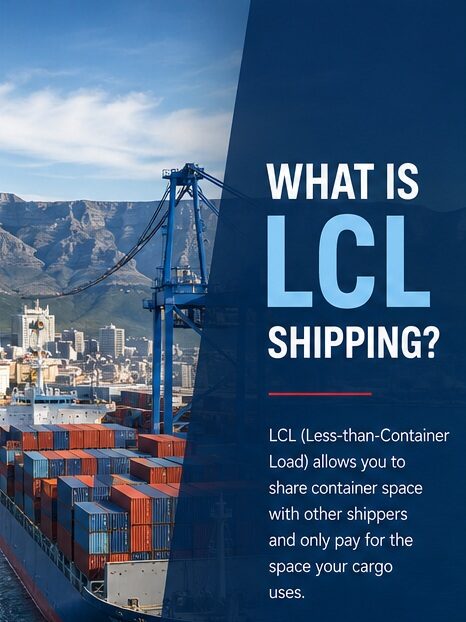
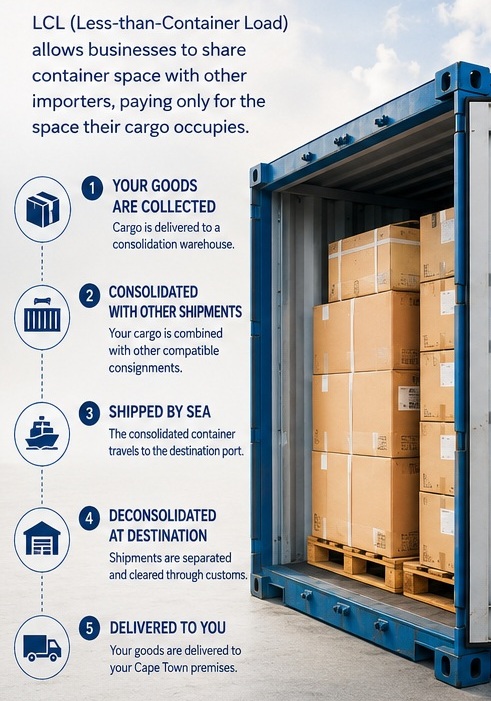
LCL stands for Less-than-Container Load. It allows businesses to share container space with other importers, paying for the space their own cargo occupies rather than paying for an entire container.
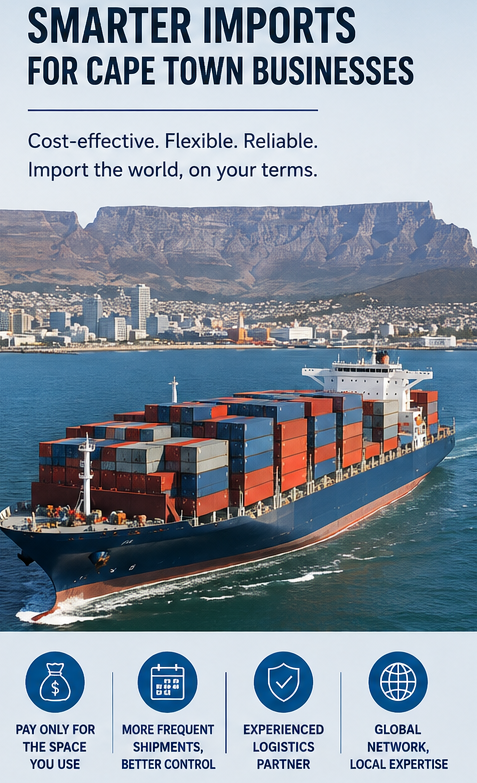
For Cape Town businesses, LCL can provide greater flexibility, better control over inventory and a cost-effective way to import smaller consignments without waiting until there is enough cargo to fill a full container.
What is LCL shipping?
LCL shipping is a form of ocean freight designed for consignments that do not require a full container.
Instead of booking an entire 20-foot or 40-foot container, your cargo is consolidated with shipments belonging to other customers. These consignments are packed together into a container and transported by sea to the destination port.
At the destination, the container is taken to a designated facility where the individual shipments are separated before being cleared and delivered to their respective recipients.
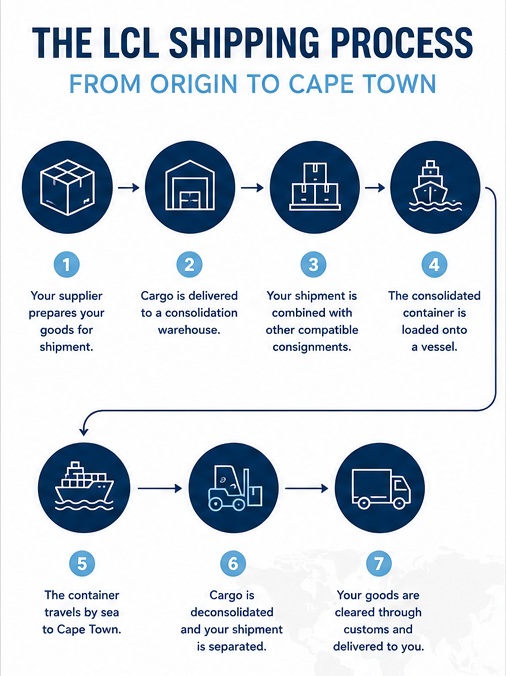
The basic process is straightforward:
- Your supplier prepares your goods for shipment.
- Your cargo is delivered to a consolidation warehouse or container freight station.
- Your shipment is combined with other compatible consignments.
- The consolidated container is transported to the port and loaded onto a vessel.
- The container travels by sea to the destination.
- At the destination, the cargo is deconsolidated and your shipment is separated.
- Your goods are cleared through customs and delivered to your Cape Town premises or another agreed destination.
South African export guidance similarly describes LCL as the consolidation of consignments from different shippers into one container, allowing smaller shipments to be transported without requiring a full container.
Why should Cape Town businesses consider LCL?
- You only need to ship the volume you have
One of the biggest advantages of LCL is that you do not have to wait until you have enough goods to fill an entire container.
For a growing Cape Town business, this can be particularly valuable. If you have ordered a few pallets of products from an overseas supplier, waiting several weeks or months to accumulate enough stock for an FCL shipment may not make commercial sense.
LCL allows you to move the goods when they are ready, helping you maintain a more responsive supply chain.
- It can reduce unnecessary inventory
Buying additional stock simply to fill a container can tie up valuable working capital.
With LCL, you can order closer to your actual requirements and replenish stock in smaller quantities. This can be especially useful for businesses selling seasonal products, products with changing demand or specialist items with relatively low turnover.
More frequent, smaller shipments can also help businesses avoid having excessive inventory sitting in a warehouse.
- It provides flexibility as your business grows
LCL can be particularly useful for small and medium-sized businesses that are still developing their international supply chains.
You may start by importing a few cubic metres of stock and gradually increase your volumes as sales grow. LCL gives you the flexibility to scale your imports without immediately committing to full-container shipments.
As your volumes increase, your freight forwarder can help you assess whether LCL remains the most appropriate solution or whether moving to FCL would provide better value.
- Cape Town businesses can access global suppliers
Cape Town is home to businesses operating across a wide range of industries, from retail and hospitality to manufacturing, construction, design and specialist services.
For companies sourcing internationally, sea freight opens access to major global supply markets. WGS Cape, for example, is headquartered in Cape Town and has more than 25 years of experience in freight forwarding and logistics. Its international network includes major Chinese ports as well as connections with markets in Asia and Europe.
This international connectivity can make LCL a useful option for Cape Town businesses that need to import smaller consignments from overseas suppliers.
- You can work with an experienced consolidator
LCL is more than simply putting a small shipment into a container. Consolidation involves coordinating suppliers, cargo collection, documentation, warehouse handling, vessel schedules, customs requirements and final delivery.
Choosing an experienced freight forwarding partner can help simplify these moving parts.
WGS Cape provides LCL and FCL ocean freight services, along with consolidation, warehousing, storage and other logistics solutions. The company also uses specialist shipping software to process documentation and has a global network of partners.
For an importer, having one experienced logistics partner overseeing the process can make international shipping considerably easier to manage.
Is LCL always cheaper than FCL?
Not necessarily.
LCL is generally attractive for smaller consignments because you are not paying for an entire container that you do not need. However, the cost per cubic metre can become less competitive as shipment volumes increase.
LCL also involves additional handling because individual consignments need to be consolidated and later separated. For this reason, businesses should compare the total landed cost of LCL and FCL rather than looking only at the headline ocean freight rate.
Your freight forwarder should be able to assess your shipment volume, origin, destination, cargo type and delivery requirements and recommend the most suitable option.
Why choose WGS Cape for your LCL imports?
For Cape Town businesses, having local expertise combined with international freight connections can be a significant advantage.
WGS Cape was founded in Cape Town and specialises in international sea freight consolidation. Its flagship LCL service is designed to accommodate freight of different sizes, while its network and relationships with shipping lines provide access to international sailing schedules and competitive freight solutions.
The company also offers dedicated customer service, cargo consolidation, warehousing and related logistics services, allowing businesses to manage more of their supply chain through one experienced provider.
Making LCL work for your business
If your Cape Town business imports smaller quantities from overseas, LCL is worth considering before automatically booking a full container.
It can provide the flexibility to import when you need to, reduce the pressure to carry excess stock and give growing businesses access to international supply chains without requiring full-container volumes.
The key is to work with an experienced freight forwarder that can assess your individual shipment and provide a transparent view of the costs, schedules and requirements involved.
For Cape Town importers, LCL can be a smart way to make international sea freight work around the needs of your business — rather than making your business work around the size of a shipping container.
WGS Cape offers LCL consolidation and international ocean freight solutions for businesses importing from major global markets. With Cape Town-based expertise and an established international network, WGS Cape can help you find an efficient shipping solution for your next import.